Magnolia Science Academy is without a doubt a Gulen Managed charter school

The Gulen Movement is fantastic at advertising, PR, and bestwowing fake honors on their students, politicians, local media and academia. The Parents4Magnolia blog is NOT American parents it is members of the Gulen Movement in damage control mode. Magnolia Science Academy, Pacific Technology School and Bay Area Technology is the name of their California schools. They are under several Gulen NGOs: Pacifica Institute, Willow Education, Magnolia Educaiton Foundation, Accord Institute, Bay Area Cultural Connection. Hizmet aka Gulen Movement will shamelessly act like satisifed American parents or students. They will lie, cajole, manipulate, bribe, blackmail, threaten, intimidate to get their way which is to expand the Gulen charter schools. If this doesn't work they play victim and cry "islamophobia". Beware of the Gulen propagandists and Gulen owned media outlets. DISCLAIMER: if you find some videos are disabled this is the work of the Gulen censorship which has filed fake copyright infringement complaints to Utube


Showing posts with label Gulen California. Show all posts

Tuesday, January 21, 2020

Get denied at LAUSD and barely approved at LA County Office of Education #GulenSchools

http://www.changethelausd.com/you_can_t_keep_a_bad_charter_down


-Alex Johnson, VP LA County Board of Education

- LA County Office of Education Staff
Header_J.jpg
As the LAUSD prepared to take the unusual step of not renewing the charters of three Magnolia Science Academies last October, their chief executive claimed that “it would be wrong to punish kids [for poor management] by closing strong schools.” After the vote, the California Charter Schools Association (CCSA) released a statement complaining that charters were no longer “evaluated mostly on the degree to which they were helping students learn.” Ignored by both parties was the fact that the CCSA itself had ranked one of these schools as a one out of ten, which in no way can be considered “strong”. The other two were at best average with ranks of four and six.
The Magnolia organization appealed the LAUSD’s decision to the Los Angeles County Board of Education. In a meeting right before Christmas, this Board ignored the findings of both the LAUSD and their own staff and renewed these charters. This means that they will continue to operate within the borders of the LAUSD without any oversight by the District, will be eligible to use District facilities under Proposition 39 and will continue to offer an inferior education to their students.
In a recent exchange on Twitter, I asked the VP of this Board, Alex Johnson, why his Board had approved an academically inferior school. His response was as follows:
 Bad-Facts_J.jpg
I provided him with the information that the CCSA had reported and he replied:
Fool_J.jpg
I followed his suggestion and looked up the staff report.
The first thing to stand out in the report is that the staff found that none of these schools had “Sound Educational Practice”. This was based on findings such as:
Johnson has refused several requests to explain how these findings represent “academic superiority”.
The members of the Los Angeles County School Board are appointed by the County Supervisors. In Johnson’s case, he failed upwards after losing to Dr. George McKenna in an LAUSD special election where the CCSA registered $80,781 as independent expenditures for his campaign. Rejected by the voters, he was appointed to represent them anyway by Mark Ridley-Thomas.
Under consideration in the state Senate is a bill that would change the way that county boards can interfere with the decisions of elected School Boards. Under SB-808, rejected charters could still appeal to the county if they felt that “the school district committed a procedural violation in making its decision”. However, instead of taking control of the oversight, the County Board would “remand the charter school back to the school district to reconsider its decision to revoke the charter.” This bill would also prohibit local districts from authorizing charters that operate in another school district.
Like most other attempts to increase local oversight of charters, The CCSA is opposed to SB-808 and is lobbying heavily to defeat the measure. They and their supporters are also spending millions on the campaigns for  LAUSD School Board candidates Nick Melvoin and Kelly Gonez to ensure that schools like Magnolia are not subject to oversight by the District. Melvoin is already giving them a return on their investment by also opposing this bill. On Tuesday, voters will get a chance to tell the CCSA and our representatives in the state Senate that they want the doors shut on failing charters like Magnolia by voting for Steve Zimmer.

Tuesday, November 26, 2019

Magnolia Science Academey Carson Co-Location should pay their bills #Gulen


https://www.latimes.com/local/lanow/la-me-edu-sharing-campuses-with-charters-20190709-story.html


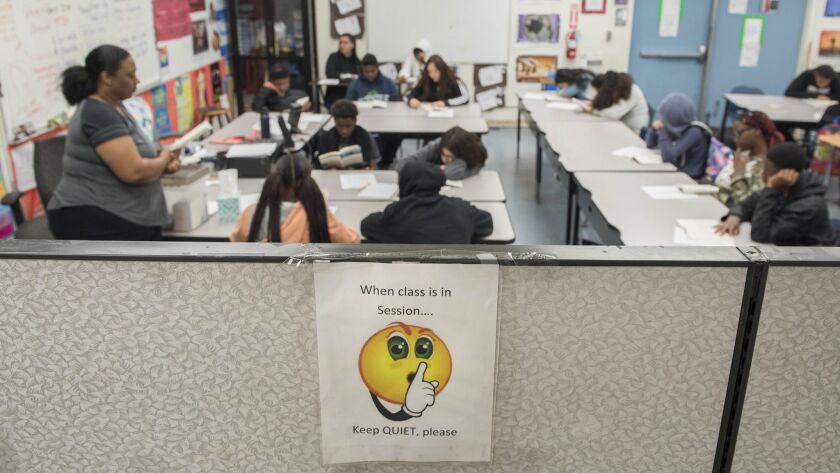
TORRANCE CA APRIL 22, 2019 -- Students at Magnolia Science Academy 3 learn in a makeshift classroom
Students at Magnolia Science Academy 3 learn in a makeshift classroom created with dividers in the school’s office space. Efforts to rent empty additional empty space on the campus of Curtiss Middle School in Carson have hit roadblocks.
(Nick Agro / For The Times)
The eighth-grade English class at Magnolia Science Academy 3 met last semester in an unusual setting: a carved-out rectangle in the school’s office, formed by portable dividers.
Cramped quarters have forced such coping strategies at the charter school, which would like to rent more space at the roomy campus it shares with Curtiss Middle School in Carson. But so far, a solution to its problem has proved out of reach.
Under state law, charters — which are privately operated — are entitled to a “reasonably equivalent” share of space on public school campuses. The Los Angeles Unified School District says Magnolia already occupies its fair share, and though the district could choose to provide more space, it won’t — for reasons officials have not clearly explained.
Nowhere are the challenges and tensions of such forced collaborations more acute than in L.A. Unified, which has more charters — 225 — than any other school system.
Access to district campuses is important to charters because land and construction costs are prohibitive. And the competition for students has become especially intense as overall enrollment in L.A. Unified has declined, threatening the viability of many schools. New charters continue to open — their growth funded by philanthropists — and they now enroll nearly one in five district students.
Los Angeles Unified has sharing arrangements at 80 campuses, more than any other district because of its size and because the California Charter Schools Assn. repeatedly has pursued litigation to enforce state rules.
But one school’s success often is seen as being at the expense of the other. Parents and teachers at numerous schools have led unsuccessful protests to keep a charter off campus. At some campuses, the district has gone so far as to demolish outdated and outlying buildings, which increases playground areas while also deterring charters from claiming available classroom space.
To school board member Richard Vladovic, putting a charter on an unwilling L.A. Unified campus almost never pans out.
“What I’ve seen is animus,” said Vladovic, who represents the Carson area and recently began a one-year term as board president. “I think it’s real bad for kids.”
The complications run big and small.
Magnolia has to throw out unopened milk every day because it doesn’t have access to refrigeration in the cafeteria.
The district-run school no longer has a band, but if it wanted to revive the program — which is in line with district goals — it would have a problem. The charter has the wing with the music rooms.
Magnolia has a band but objected to the district’s designation of a music room, with built-in risers, as its classroom for disabled students, because some of them have mobility problems.
To work around that, the charter swapped access to the library for possession of an empty space that used to be a weight room adjacent to the gym. That room has its own bathrooms and the floor is flat.
The two principals are cordial in managing day-to-day issues, although Magnolia Principal Shandrea Daniel has a list of things she’d love to improve. Her assigned “science lab,” for example, has only one sink and lacks such built-ins as Bunsen burners and an eyewash station.
And the small central area between Magnolia’s classroom buildings is where Curtiss keeps its dumpsters.
“What kind of message does that send to my students?” Daniel asked.
TORRANCE CA APRIL 22, 2019 -- Shandrea Daniel, principal of Magnolia Science Academy 3, stands in th
Magnolia Principal Shandrea Daniel stands in front of the dumpsters that occupy the area between her classroom buildings. She’d like them removed or enclosed.
(Nick Agro / For The Times)
She’d like the dumpsters moved elsewhere or completely enclosed.
Curtiss Principal Gina Russell-Williams said there has been a “productive and positive” relationship between the schools but declined to comment about ongoing issues.
“My opinion is moot unless the district OKs it,” she said.
Board member Nick Melvoin said that campus sharing is unavoidable under state law and frequently works well. True collaboration, he said, can help students at both schools. He helped organize a retreat last year — funded by a pro-charter group — that sought to build ties between district schools and charters.
At first glance, Curtiss Middle School, with a drab two-story main classroom building, doesn’t look like much of a prize. But with nearly 20 acres, both programs have access to an expansive grass field — a rarity at many district campuses. The children from the two schools stay separated in their own halves and use the gym at different times.
TORRANCE CA APRIL 22, 2019 -- Students at Magnolia Science Academy 3, left, pass students from Curti
Different schools; different uniforms. Magnolia charter students, left, pass students from Curtiss Middle School, in yellow, during physical education. The playground is permanently split between the two schools.
(Nick Agro / For The Times)
There are lots of classrooms — 59 of standard size and nine smaller ones — and L.A. Unified has been struggling to fill them. The school has 477 students — up from a low of 442 two years ago, but down from 964 less than 10 years ago. Now there are just 170 students from local neighborhoods at Curtiss. Its other students are part of a “magnet,” which buses in students who have chosen Curtiss as an alternative to their own neighborhood schools.
Curtiss, which serves grades six through eight, has its virtues, including a partnership with a local community college that allows eighth-graders to earn college credits, coursework in robotics and computer coding and a new “maker’s space,” in which students carry out class projects that involve hammers, saws and recycled materials. In physical education, students can use rowing machines, an exercise bicycle and a StairMaster.
But the notable growth has been at Magnolia, which started about 10 years ago and peaked at about 510 students this year — at least 40 of them from the Curtiss attendance area. Magnolia takes particular pride in its athletics and its music program and a technology focus that includes a robotics team and computer coding classes. The school’s grade span is six through 12, which allows it to offer Advanced Placement courses in computer science and other subjects.
Students at each school perform similarly on state standardized tests. Both are split fairly evenly between black and Latino students from low-income families.
Magnolia’s growth rests in part on attracting students — about 40% of them — from places such as Torrance, Compton, Inglewood and Long Beach, all outside of the district. But L.A. Unified is obligated to provide space only for students who live within district boundaries.
The district-run school — with fewer students than the charter — is using 38 full-size classrooms and five smaller ones, compared with 19 being used by the charter. Even so, there still are five unused classrooms and four unused smaller rooms in the Curtiss Middle School portion.
TORRANCE CA APRIL 22, 2019 -- An unused classrooms at Curtiss Middle School in Carson on Monday Apri
An unused classroom at Curtiss Middle School in Carson, as seen through a glass pane on the door.
(Nick Agro / For The Times)
Curtiss has the luxury of setting aside two rooms for testing and four in which students can receive special academic help outside of their regular classes.
Meanwhile, on the charter side, two classrooms are set up using dividers in the office space. Teacher Angela Smith rotates in, as do others. On a recent Monday, her class was studying an essay in which Holocaust survivor Eli Wiesel described his impulse to write.
“Follow along when I read because you’re going to continue on as I ask you to finish my sentence,” Smith tells students.
“Did I write it so as not to go mad or, on the contrary, to go mad in order to — what?”
‘’Understand the nature ...” a few students continue haltingly.
“Keep going,” she urged.
The students continue with more voices and more volume: “… the nature of the madness, the immense, terrifying madness that had erupted in history and in the conscience of mankind?
On the other side of the divider, where office staff must pass, someone has taped a piece of paper decorated with a shushing emoji that warns: “Keep QUIET, please.”
Magnolia pays L.A. Unified about $310,000 a year for its share of the campus, and Daniel said she would happily pay for more classrooms — money that could go toward programs at Curtiss.
But L.A. Unified isn’t taking the deal — one senior manager suggested that the district would not provide more space until the charter dealt with unpaid fees well in excess of $250,000. These potential penalties were a result of Magnolia overestimating how many of its students live within district boundaries, he said.
Magnolia officials say the issue of unpaid fees is news to them, and the district subsequently said that the matter is under review.
The district and the Magnolia organization have clashed before.
Several years ago, L.A. Unified faulted Magnolia schools for importing nearly 100 teachers and other school employees from Turkey in possible violation of rules on overseas hires.
Magnolia has discontinued this hiring, but L.A. Unified refused to reauthorize the charter of Magnolia Science Academy 3. The school was on the verge of being closed until the L.A. County Office of Education stepped in to renew the charter. The county office now oversees the school, but L.A. Unified must still house it — an arrangement that rankles some in the district.
Curtiss Principal Russell-Williams tries to stay above the fray on the competition for resources and students.
“All schools have challenges because parents have choices,” she said. “That just goes without saying for every school.”

Monday, October 22, 2018

Bay Tech Charter School aka Bay Area Technology School sister schools to Magnolia Science Academy #FinancialMismanagement #Embezzlement


Bay Area Technology School Notice of Concern #GulenSchool from Gulen Cemaat

ARTICLES ON BAY TECH CHARTER SCHOOL OR BAY AREA TECHNOLOGY SCHOOL 
click to enlargeOUSD officials are trying to stabilize the tottering organization. - BAYTECHSCHOOL.ORG
  • BayTechSchool.org
  • OUSD officials are trying to stabilize the tottering organization.

Amid a management crisis and allegations of fraud at Oakland's BayTech charter school, the Oakland Unified School District is exploring the possibility of appointing an independent director to the school's board. State law allows public school districts to make board appointments to charter schools under their supervision. BayTech has also hired Kathleen Daugherty, a retired superintendent from Sacramento who runs an education consulting firm, to assist with the school's recovery. Classes began on Monday at BayTech, even though the school's principal and several other senior administrators all abruptly quit at the end of the last school year.
Meanwhile, OUSD is continuing to investigate allegations that the school's former principal, Hayri Hatipoglu, defrauded BayTech by modifying his employment contract to obtain a lucrative three-year payout, instead of a standard six-month severance package. BayTech's three current board members, Fatih Dagdelen, Kairat Sabyrov, and Volkan Ulukoylu, allege that Hatipoglu made the contract modification without their knowledge.
But Hatipoglu wrote in an email to the Express that the allegations are untrue and have unfairly damaged his reputation.
"This allegation is such a big lie that even OUSD, CSMC (BayTech back office) would be able to refute that immediately as they can view/have access to school finances," Hatipoglu wrote.
OUSD hasn't commented about the school's situation or the allegations against Hatipoglu except to confirm several weeks ago that the district is conducting an investigation. School district records show that OUSD has obtained detailed financial information from BayTech.
READ END OF ARTICLE HERE https://www.eastbayexpress.com/oakland/oakland-unified-moves-to-save-gulen-movement-charter-school/Content?oid=19153824

More Allegations of Embezzlement at Oakland's BayTech Charter School

The school district is investigating "questionable credit card charges" for expensive meals, cruises, and Disney tickets.

By Darwin BondGraham

https://www.eastbayexpress.com/SevenDays/archives/2018/08/17/more-allegations-of-embezzlement-at-oaklands-baytech-charter-school
BAYTECHSCHOOL.ORG
  • BAYTECHSCHOOL.ORG

OUSD officials are investigating numerous questionable purchases made using the Bay Area Technology School's credit card, according to a notice of concern sent by the district to the charter school.

The newly revealed allegations are part of a broader investigation by OUSD into financial mismanagement at the school and include accusations by BayTech's three current board members against the school's former principal that he fraudulently altered his employment contract. The former principal, Hayri Hatipoglu, has accused the school's board of defaming him.

The review of the school's credit card spending was revealed in a July 12 notice of concern sent by OUSD's charter schools oversight office to BayTech's leaders. The district also wrote that BayTech has a system of "inadequate financial checks and balances."

OUSD flagged purchases from Netflix, Amazon, and numerous expensive restaurant bills as cause for concern. It's unclear if the purchases had any legitimate educational purpose.

The district also found $6,800 in payments to Commodore Cruises and Events, an Alameda-based cruise ship operator. BayTech's credit card was also used to purchase $2,919 in Disneyland tickets. The school paid for hotels and plane tickets for staff to travel to Southern California, Arizona, Utah, and Texas.

Copies of BayTech's credit card statements from 2016 and 2017 obtained by the Express through a California Public Records Act request show that the school paid $2,655 to an upscale Oakland pizzeria over a two-year period. The school's Wells Fargo credit card was also used to pay for six separate meals at Scott's Seafood in Oakland costing a total of $4,453.

Last year, the school's credit card was used to buy $32,698 in Apple electronics. According to former school staff who spoke with the Express on the condition of anonymity, some Apple products were given to staff as thank-you gifts and not used for official school purposes.

The district is currently investigating the school for financial mismanagement, and BayTech's board has also hired an independent firm, Oracle Investigations, to review allegations of embezzlement and fraud.

Former Principal Alleges Oakland's BayTech School Was Source of Funding for Gülen Movement 

https://www.eastbayexpress.com/oakland/former-principal-alleges-oaklands-baytech-school-was-source-of-funding-for-gulen-movement/Content?oid=19390167

Hayri Hatipoglu said the charter school is a moneymaker for the shadowy Turkish political force led by Fethullah Gülen.

click to enlargeBAYTECHSCHOOL.ORG
  • BayTechSchool.org
In recent weeks, Oakland's Bay Area Technology School has become the center of a management crisis and accusations of fraud. Now, the school's former principal, Hayri Hatipoglu, alleges that the embattled charter school was used to bankroll a religious and political movement that was accused by Turkey's Prime Minister Recep Tayyip Erdogan of participating in an attempted 2016 coup.
In an interview with the Express last week, Hatipoglu said employees of the school — many of them Turkish immigrants — handed over thousands of dollars from their own salaries for the cause in exchange for the H-1B visas allowing them to work in the United States.
Hatipoglu said he resigned and left for Australia, where he is a citizen. He said he no longer wanted to allow the Gülen movement to exploit the school. And he said the allegations of fraud against him by BayTech's board of directors are false.
The Oakland Unified School District is currently investigating Hatipoglu for possibly embezzling thousands of dollars from the school by using its credit card to make unauthorized purchases, and for allegedly altering his employment contract without the board's knowledge. Hatipoglu's employment contract provided him with a fixed three-year term of employment. The contract stipulated that if he was terminated, or quit, without cause, the school would owe him the remaining pay for the rest of the three-year term. Fatih Dagdelen, a BayTech school board member who is accusing Hatipoglu of fraud, claimed in a recent email to OUSD officials that the true term of the contract was six months, not three years.
Hatipoglu denies that he stole from BayTech or altered his contract. But the former principal said all the allegations about BayTech's links to the Gülen movement are true.
Public records support some of Hatipoglu's claims.
"The school gave Turkish teachers employment because the school applies for their visas, and when they give donations, they get to work," said Hatipoglu. "I told [BayTech's board] I'd no longer do this because there have been so many allegations, and the Turkish government is looking into it."
Hatipoglu is one of the first high-level administrators of a Gülen school to describe the ways the movement allegedly extracts money from the many charter schools its followers operate.
The Gülen movement is led by an elderly Turkish imam named Fethullah Gülen who lives in exile in Pennsylvania. Gülen and his thousands of followers around the world have been labeled terrorists by the Turkish government. In recent years, Turkish intelligence agents have fanned out across at least 18 nations to spy on, and sometimes seize, Gülenists and take them back to Turkey where they are jailed and tortured, according to recent reports in The New York Times and other media.
Gülenists claim to be moderate Islamists concerned about the erosion of democracy and secularism under Prime Minister Erdogan's conservative government. They are pro-science and pro-capitalism, and the movement is as much a business network as it is a religious sect. Its followers wielded considerable political power in Turkey until the crackdown that followed the 2016 coup.
Erdogan has accused the United States of harboring Gülen and allowing his movement to operate a network of over 100 charter schools in California, Nevada, Texas, Arizona, and other states. Altogether, Gülen-linked schools receive hundreds of millions in public funds.
There have long been concerns in Oakland that BayTech is a Gülenist school, but the Oakland Unified School District never seriously investigated. Meanwhile, BayTech's administration and board members have repeatedly denied the accusations. In fact, Hatipoglu even said the school had no links to the movement at an OUSD board meeting last November. And BayTech board members have called anyone who raises questions about ties to the Gülen movement "racist."
But since the end of the last school year, when several senior staff and two school board members resigned, and the district began investigating, questions have emerged about whether BayTech is being used as a source of support for the Gülenists in their conflict with Erdogan's government.
Hatipoglu came to BayTech in 2011 from Australia on a work visa. When asked by followers of Fethullah Gulen who are linked to the school to make a contribution to a Gülen-linked organization, he said he initially agreed.
"They said Gülen was doing educational services, helping the poor and needy in Africa, dialogue, and world peace," said Hatipoglu. "Does that sound good to you? I willingly gave donations because I believe in this and didn't know it was compulsory.
"When I said 'no,' I saw the ugly face," said Hatipoglu. "Before that, it was all a beautiful mask."
Hatipoglu said he helped prepare visa applications for teachers, most of them from Turkey, to come work at BayTech. He said teachers were expected to make monetary contributions to Fethullah Gülen in exchange for their visa.
"Turkish teachers have to donate this money to stay and work in America," said Hatipoglu.
According to federal Department of Labor records, BayTech obtained at least 29 H1-B visas since 2009 to employ foreign educators, mostly from Turkey. The number of foreign teachers was unusual for a single small school.
Multiple calls and emails to BayTech board members Dagdelen, Sabyrov, and Ulukoylu seeking comment about Hatipoglu's allegations regarding the school went unreturned. The three currently oversee BayTech's $4 million budget of state and federal funds.
Asked at BayTech's most recent school board meeting on Aug. 6 whether they are followers of Fethullah Gülen or if the school has any links to the Gülen movement, both Dagdelen and Ulukoylu declined to comment.
Hatipoglu claims that he pushed for BayTech to distance itself from the Gülen movement first by having BayTech cut ties with the Accord Institute, a nonprofit that was founded by Gülenists and sells education services to Gülen-linked charter schools. BayTech was also founded by Gülen movement members, including the current CEO of the Accord Institute, and multiple sources said BayTech paid the Accord Institute about $70,000 a year for several years for various education training services.
Hatipoglu said he wanted BayTech to free itself from Accord due to bad publicity. Accord was the subject of investigations by the Los Angeles Unified School District and the California State Auditor, which established that there were conflicts of interest and weak financial controls. Accord, and a chain of Los Angeles charter schools founded by followers of Gülen, were also the subject of a story in LA Weekly that uncovered evidence that the schools were used to raise money for Fethullah Gülen.
BayTech did, in fact, cut ties with Accord last year. But Hatipoglu claims that he also wanted to put an end to the practice of bringing Turkish teachers over on H1-B visas and having them contribute money to the Gülen movement. Also, he wanted to recruit directors to BayTech's board who are not followers of Fethullah Gülen.
"This is where we all broke apart," said Hatipoglu.
School board emails obtained by the Express reveal that BayTech director Volkan Ulukoylu was attempting to resign earlier this year and replace himself with a man name Volkan "Adam" Kaya. Ulukoylu shared a brief bio and photo of Kaya with Sabyrov, Dagdelen, Hatipoglu, and Alretta Tolbert, one of the board members who resigned after Hatipoglu left the school.
Hatipoglu said that he was opposed to Kaya joining the board because Kaya has links to the Gülen movement.
According to tax records, Kaya is a director of Bay Area Cultural Connections, a Sunnyvale nonprofit affiliated with the Pacifica Institute — which describes itself as an organization inspired by Fethullah Gülen. The Express was unable to reach Kaya for comment.
Hatipoglu, now residing in Australia, said he's fearful because he has been identified as a Gülenist in reports in the Turkish media about BayTech's unraveling. He insisted he's innocent of defrauding the school and that the board, in fact, approved his three-year fixed-term contract on March 8 of last year.
Minutes from BayTech's March 8, 2017 board meeting are missing from the school's website, a violation of the Brown Act. OUSD had warned the school about violating the state's open-meetings law.
But a copy of BayTech's board minutes obtained from OUSD indicate that the board did, in fact, approve a fixed three-year term employment contract for Hatipoglu.
Sabyrov, in a June 27 email to OUSD officials, wrote that the board was tricked into approving the contract and that his audio tape of the meeting shows the board thought they were voting on a six-month term, not three years.
OUSD has yet to finish its investigation.
READ THE CONNECTION TO CORAL ACACDEMY OF SCIENCE ON NELLIS AIRFORCE BASE
prior prinicpal Ercan Aydogdu


Bay Area Technology Charter School - Magnolia's Gulen Sister school in Oakland under investigation #Embezzlement


Bay Area Technology School Financial Mismanagement Gulen School from Gulen Cemaat

click to enlargeAt an OUSD board meeting last November, BayTech Principal Hayri Hatipoglu angrily denounced questions about his school’s ties to the Gulen movement.
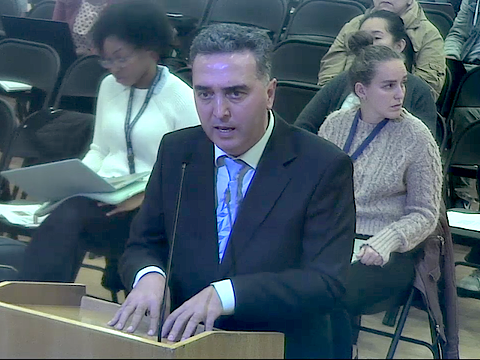
  • At an OUSD board meeting last November, BayTech Principal Hayri Hatipoglu angrily denounced questions about his school’s ties to the Gulen movement.
https://www.eastbayexpress.com/oakland/baytech-charter-school-under-investigation-for-financial-mismanagement/Content?oid=18890699

Just before the end of the last school year, the principal of Oakland's Bay Area Technology School, Hayri Hatipoglu, suddenly resigned. At least four other senior staff and two of the charter school's five board members also abruptly quit. As a result, the organization was thrown into chaos. And then Hatipoglu disappeared. According to several sources, he left the country with his family for Australia, where he is a citizen.
Afterwards, the Oakland Unified School District, which is responsible for overseeing the BayTech charter school, opened an investigation. BayTech's three remaining board members also hired an independent party to carry out their own internal review.
While OUSD and BayTech have both attempted to keep the mini-crisis under wraps, the Express has learned that BayTech's three remaining board members are accusing Hatipoglu of defrauding the school. They allege that Hatipoglu surreptitiously changed his employment contract to provide himself with three years' worth of severance pay totaling about $450,000, an unusually large sum for a small school with an annual budget of approximately $3 million. His previous contract provided for only six months of severance pay, a standard in the education sector.
"We believe he changed his contract," said BayTech board member Fatih Dagdelen in a recent interview. "According to his contract, he'd get paid a six-months salary if he resigned, but all of a sudden his contract said he'd get paid two-and-a-half years further."
As to why Hatipoglu resigned, Dagdelen declined to say, but he added, "we have a lot of evidence and believe there's a fraud."
Hatipoglu has countered that he did nothing wrong. Instead, he alleges that Dagdelen and two other BayTech board members are part of a "shady network" trying to "take over" the school.
In an unusual and unsolicited email to the Express sent on June 28, Hatipoglu wrote that the school's Turkish board members conspired to punish him for his decision to break ties with a Southern California-based nonprofit. The nonprofit, Accord Institute, happens to be controlled by the followers of a powerful Turkish imam who leads a global Islamic political force called the Gülen movement.
Founded in the 1970s by the religious leader Fethullah Gülen, the Gülen movement is an Islamic-inspired social and political force that globalized as its followers immigrated to Europe, Australia, and the United States. The Turkish government considers the Gülen movement a terrorist organization because its members helped organize the 2016 coup attempt against President Recep Erdogan, and Erdogan has ordered thousands of Gülenists jailed. (The U.S. government, however, does not classify the Gülen movement as a terrorist organization.) Fethullah Gülen currently lives in self-exile in Pennsylvania, but he's considered one of the most powerful men in Turkish politics. His followers also set up and operate one of the largest chains of charter schools in the U.S. BayTech is one of these schools.
Former BayTech staff told the Express that for years there have been questionable financial practices at the school. They also confirmed that leading up to Hatipoglu's departure, there appeared to be a split between the school's Turkish directors and the former principal, but the cause of the falling out wasn't apparent. Non-Turkish staff and board members at the school said they have mostly avoided inquiring into the school's links to the Gülen movement.
But over the past decade, OUSD received multiple complaints asking that BayTech's rumored ties to the Gülen movement be closely examined. BayTech's leaders condemned these critics, however, calling any attempts to question the school's ties to Fethalluh Gülen's followers a form of discrimination.
At the OUSD board meeting last November, when BayTech was seeking to renew its charter, several members of the public questioned why the school district hasn't investigated. Hatipoglu responded angrily at the meeting by denying any link to the Gülen movement.
"It's worrisome for me that politics and education are in the mix here because whatever BayTech does, it goes through district oversight, state oversight," Hatipoglu said. "Is there one concrete example? Show me. It's all about slander."
According to Joshua Hendrick, a professor of sociology at Loyola University Maryland, many followers of Fethullah Gülen actually deny being part of the movement. This is especially true of Gülenists who have organized charter schools in the U.S.
OUSD officials have largely ignored BayTech's links to the Gülen movement, and the district had declined to investigate the school. But now, following the departure of the principal and other staff and allegations of fraud, OUSD confirmed that they've opened an investigation.
"OUSD takes seriously any allegations of financial mismanagement in our schools," district spokesperson John Sasaki wrote in an email. "As the charter authorizer, we have been informed of allegations of financial impropriety at BayTech."
According to BayTech's board meeting minutes from July 20, OUSD sent the charter school a Notice of Concern that outlines potential fiscal and managerial problems at the school.
Just eight months prior, OUSD's charter schools oversight office concluded that BayTech was fully in compliance with all fiscal controls. In a memo to OUSD's board, Superintendent Kyla Johnson-Trammel and Silke Bradford, who led OUSD's office of charter schools until February, wrote that allegations made against the school regarding fiscal mismanagement were "completely unfounded."
Johnson-Trammel and Bradford also wrote that claims that BayTech is linked to the Gülen movement — which the FBI has investigated for misusing public funds — are false. They concluded that critics of the Gülen movement who pointed out the school's ties were "racist." Following this assessment, OUSD's board renewed BayTech's charter to operate.
But BayTech's direct links to the Gülen movement are readily apparent.
BayTech, which is run by the nonprofit Willow Education foundation, was founded with a $450,000 state Department of Education grant in 2003 by Suleyman Bahceci, a prominent member of the Gülen movement who has set up other charter schools in Texas, Utah, and Southern California.
Bahceci didn't respond to an email seeking comment for this report.
Robert Amsterdam, an attorney working on behalf of the Turkish government, has identified Bahceci as one of the Gülen movement's key organizers in the U.S. charter school industry.
"Charter schools are free money for them," said Sharon Higgins, an Oakland resident who has closely followed the Gülen movement's expansion into the U.S. education sector. "If they get a school opened, they can bring their members to the U.S. They have a lot of H-1B visas to get their members here, so it's a way to increase their membership in the U.S. and tap into public funds."
Willow Education has obtained numerous H-1B visas to hire teachers from Turkey and other countries where the Gülen movement is strong. According to U.S. Department of Labor records, since 2009, Willow Education used 29 separate visas to hire math, science, English, and Turkish language instructors.
One of these visas was assigned to Hatipoglu. He immigrated to the U.S. from Australia, although he is of Turkish origin. Former BayTech staff told the Express that Hatipoglu took over BayTech at a time when the school was struggling financially and that he was able to turn it around. Parents and teachers at the school told the Express that the school has excelled academically, even if BayTech has run into management and financial problems.
In addition to Bahceci, other past BayTech staff and board members have obvious ties to the Gülen movement, according to records and interviews.
One key link is through the Accord Institute, a nonprofit charter school management company that was established by Bahceci and other Gülen movement members.
In Los Angeles, the Gülen movement set up several charter schools called the Magnolia Science Academy. These schools were audited in 2014 and 2015 by the Los Angeles Unified School District's Inspector General and the California State Auditor. Both series of audits found numerous problems including weak financial controls, bad record keeping, and mismanagement. The Magnolia schools were found to be paying Accord hundreds of thousands of dollars a year for services, but it's unclear what Accord did with the money. In addition, Bahceci ran Magnolia schools when the lucrative contracts with Accord were signed, and then he later moved back to Accord. Auditors ultimately found nothing illegal in the dealings, however.
Baris Cagdaser helped found Willow Education and BayTech alongside Bahceci and served on BayTech's board until 2012. Cagdaser was also on the Accord board of directors with Bahceci. And Accord's current CEO, Matt Avsaroglu, was a cofounder of BayTech and worked there until 2009.
Like the Magnolia schools in Los Angeles, BayTech also had a relationship with Accord, although it's unclear how much BayTech was paying them. BayTech hasn't posted financial information about its dealings with Accord on the school's website. Additionally, BayTech is missing copies of its board meeting agendas and minutes from years prior to 2009, and hasn't posted minutes for any other board meetings held prior to August of last year.
Hatipoglu alleges that he's a victim of retaliation by BayTech's three Turkish board members because he tried to cut ties with Accord. In his email to the Express, Hatipoglu wrote that last year he moved to have Accord's contract terminated due to the controversy around its dealings with the Los Angeles Magnolia schools. But according to Hatipoglu, Accord's CEO responded by retaliating. "He indicated to me that I made a huge mistake and that I would pay."
Several calls to Accord went unreturned.
At BayTech's board meeting on Monday, two of the school's three remaining directors, Dagdelen and Volkan Ulukoylu, declined to say whether the school is linked in any way to the Gülen movement. In response to Hatipoglu's allegations about a "shady network" trying to control the school, Ulukoylu said he had "no idea" what the former principal was talking about.
Dagdelen said he couldn't comment further about Hatipoglu's alleged fraud, but he added that just three days after BayTech opened its investigation, Hatipoglu appeared to have left the country.
PART II of ongoing investigation
https://www.eastbayexpress.com/SevenDays/archives/2018/08/10/oaklands-baytech-charter-school-violated-multiple-state-laws
click to enlargeBAY AREA TECHNOLOGY SCHOOL
  • BAY AREA TECHNOLOGY SCHOOL

The Bay Area Technology School violated state education laws when it required students and their families to purchase uniforms, graduation tickets, and caps and gowns, according to the Oakland Unified School District. All students were made to purchase uniforms from the Oakland charter school only, a violation of the education code. 

Graduating 8th and 12th graders were made to purchase caps and gowns from the school, and their family members were required to buy $10 tickets to attend the ceremony. 

These practices went on for several years, according to school staff who asked not to be identified for fear of retaliation. BayTech even warned parents on its website that students would only be allowed to wear BayTech branded jackets, sweaters, and shirts, and that students could face discipline if they didn't don the clothing.

The proceeds BayTech collected from these illegal activities amounted to thousands of dollars, said several sources. It's unclear what the school's administration did with the money.

OUSD authorities ordered BayTech to put a stop to these practices on June 8, according to a notice of concern sent to the charter school's board and interim co-principals by Leslie Jimenez, OUSD's charter school coordinator.

In a separate notice of concern sent a week earlier, OUSD officials warned BayTech leaders that they repeatedly violated California's Brown Act, which requires that charter schools provide public access to meetings because they receive public funding.

According to OUSD, BayTech's board convened meetings in February that were essentially secret because no notices or agendas were posted to inform the public.

The school board also convened meetings via email without notifying the public. The purpose of one of these online meetings was to recruit a new board member. The potential replacement was a Richmond resident originally from Turkey.

In March, BayTech's school board failed to post agendas for two separate board meetings on BayTech's website. And in May, the board posted an incorrect date for a board meeting and then issued an agenda after a mandatory deadline, thereby hampering the public's ability to participate.

Furthermore, OUSD found that three of the school's board members withheld documents from two board members. The recent notice of concern sent by OUSD to BayTech didn't identify which board members were prevented from accessing the records, or what specifically the records pertained to.

The numerous financial and transparency violations came to light after OUSD announced that it was investigating BayTech for mismanagement.

The district's investigation was initiated after BayTech's principal, Hayri Hatipolgu, suddenly resigned at the end of the past school year. Several other senior staff also quit the school, and two board members, Alretta Tolbert and Gina Miller resigned, as well. The sudden departure of the board members and staff have thrown the school into chaos.

The three remaining board members, Fatih Dagdelen, Kairat Sabyrov, and Volkan Ulukoylu, are now accusing Hatipoglu of defrauding the school by surreptitiously changing his employment contract to give himself a three-year payout worth hundreds of thousands of dollars if he resigned, instead of a six-month payout worth much less.

Hatipoglu has fired back at the three remaining board members by accusing them of being part of a "shady network" that is trying to "take over" BayTech. But since he resigned, the Express has been unable to contact Hatipoglu.

Looming over the school's management crisis is its relationship to a larger network of charter schools that were established by followers of Fethullah Gulen, a Turkish imam who has been accused of plotting the 2016 coup against the Turkish government. Gulen resides in Pennsylvania.

BayTech's three current board members are all Turkish. When asked at the school's board meeting earlier this week if the school is linked to the Gulen movement, both Dagdelen and Ulukoylu declined to answer.

According to OUSD records, the district is reviewing BayTech's finances to see if any money was misappropriated. Hatipoglu's employment contract is also being examined to determine if the allegations against him are true.

BayTech's first day of school is August 13 and the school has hired an interim CEO to assist with reconstituting the board and getting the organization's affairs in order. OUSD is also considering appointing a board member to BayTech.

update 10/26/2018
CONNECTION TO CORAL ACADEMY OF SCIENCE ON NELLIS AIRFORCE BASE
ERCAN AYDOGDU